


The journey of a thousand miles
begins with a single step.
Lao Tzu
Person Centred Therapy |
EMDR Therapy
Person centred therapy can help with a wide range of challenges, from anxiety and low self-esteem to relationship difficulties and life transitions. Whatever brings you here, you don't have to face it alone.
You deserve support that sees the whole of you — not just your problems, but your strengths, your resilience, and your potential to grow.
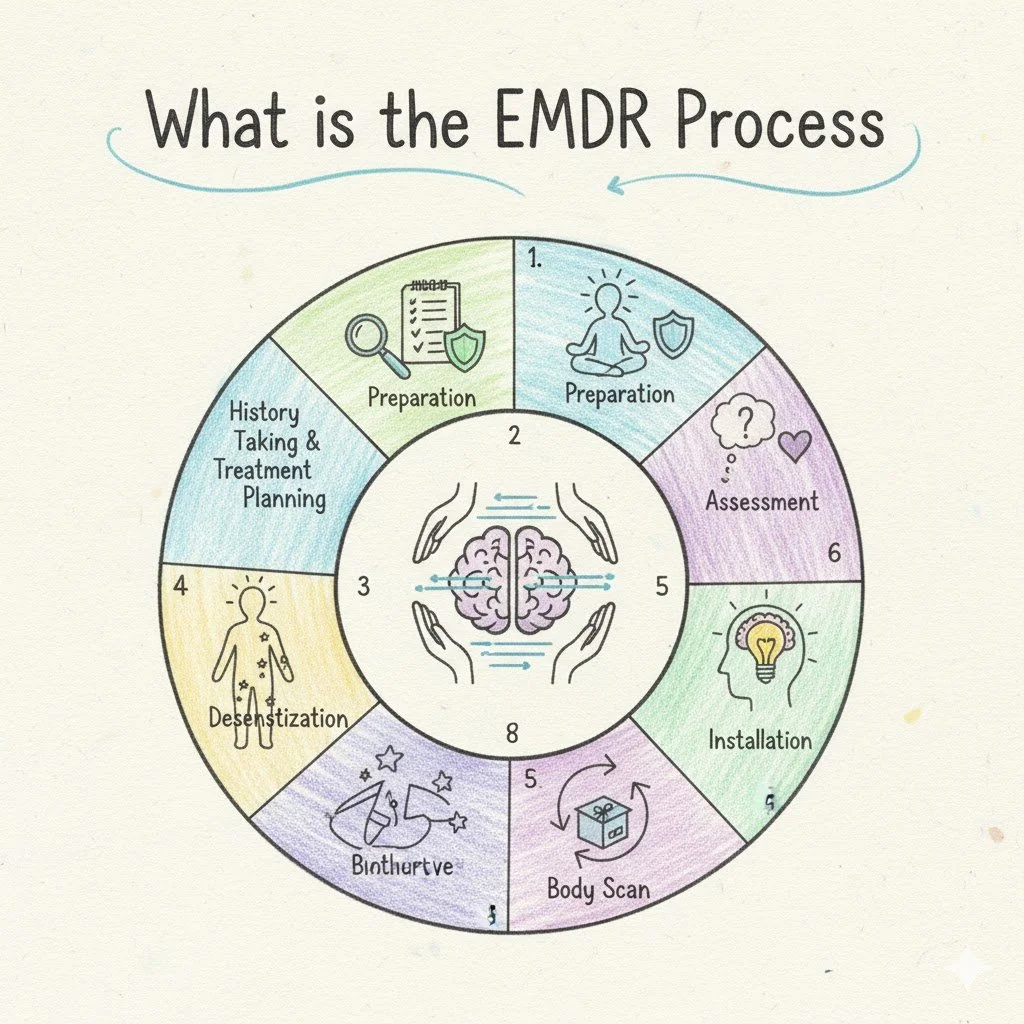
EMDR Therapy EMDR (Eye Movement Desensitization and Reprocessing) therapy offers a proven, evidence-based path to recovery that helps your brain process and move on from trauma and adversities.
EMDR:
Sometimes, no matter how much insight we gain or how many times we talk something through, certain experiences just don’t seem to shift. You might understand why something affects you, and yet you have physical responses to it and you find yourself reacting in ways you can’t seem to control.
When we go through something overwhelming or distressing, our brain can struggle to process the experience properly. Instead of the memory being filed away like most others, it can feel stuck or frozen — stored with all the original emotions, physical sensations, and beliefs intact. So even years later a particular situation can make it feel as though the past is happening all over again.
This is where talking alone can have its limits. Conversation engages the thinking, reasoning part of our brain — which is incredibly useful, but it doesn’t always reach the deeper place where these frozen memories are held.
Trauma is not confined to single event experiences or those we typically think of when we hear the word trauma. Trauma can also be from relational.
Relational trauma develops when our closest relationships — particularly in childhood, but sometimes in adult life too — become a source of fear, confusion, or pain rather than safety and comfort. Because human beings are fundamentally wired for connection, when the relationships we rely on feel unpredictable, threatening, or emotionally absent, the impact can be profound and far-reaching.
Relational trauma can develop through experiences like:
∙ Emotional, physical, or sexual abuse within a close relationship
∙ Growing up with a parent who was emotionally unavailable, depressed, or struggling with addiction
∙ Chronic criticism, humiliation, or feeling like you were never quite good enough
∙ Neglect — not necessarily physical, but emotional; simply not being seen or attuned to
∙ Walking on eggshells around an unpredictable or volatile caregiver
∙ Losing an important attachment figure through death, abandonment, or sudden separation
∙ Coercive control or abuse in an adult romantic relationship
∙ Being repeatedly let down by people you trusted
What makes relational trauma particularly complex is that it often happens within relationships where love was also present — which can make it harder to name, harder to make sense of, and harder to heal from.
How it can show up in adult life:
Because relational trauma is rooted in our earliest experiences of connection, its effects can be far reaching. You might notice it in:
∙ Difficulty trusting others, or trusting your own instincts about people
∙ Relationships that feel intense, complicated, or that follow painful patterns
∙ A tendency to either cling to closeness or avoid it altogether
∙ Deep shame, or a persistent sense of being fundamentally flawed or unlovable
∙ Emotional responses that feel bigger than the situation seems to warrant
∙ Anxiety, hypervigilance, or always waiting for something to go wrong
∙ Difficulty knowing what you feel, what you need, or who you really are
∙ Physical symptoms — tension, fatigue, chronic pain — that don’t have a clear medical cause
Any of these patterns, while painful, make complete sense when understood through the lens of attachment. They are adaptations — intelligent responses to what you once needed to survive emotionally. The difficulty is that they tend to create the very disconnection that causes you problems in your every day life.
Person centred and attachment informed EMDR goes deeper, identifying the roots of the patterns and providing opportunities to have important emotional experiences that support the nervous system to heal and rewire.
Get in touch to discuss your needs for person centred therapy or if you are interested in looking at how EMDR may help you within a Person-Centred therapy approach.
My background is person centred therapy. I believe a warm, affirming therapeutic relationship is the core of healing work.
A place to be yourself.
Healing and change take time and the foundation for which begins in a place you can be open about your feelings and all the parts of yourself.
I also offer EMDR, an approach developed to reduce the affects of trauma that talking therapy sometimes cannot reach. EMDR can be beneficial within the context of a trusting therapeutic relationship following the therapist supporting and guiding you through developing the internal resources and feelings of safety to explore difficult experiences.
My Approach
Session Prices:
My fees: £60 per session (50 minutes)
(session prices to increase to £65 in September 2026)
Non judgemental
Empathic
Affirming
Individual
Why Choose EMDR treatment?
NICE approved treatment for trauma and PTSD
Effective for both recent and historical trauma and adverse events
No need to re-live traumatic events in detail
Combines seamlessly with person-centered counselling approaches
You don't have to carry the weight of past experiences alone. Take the first step toward healing and reclaim your life with compassionate, professional EMDR therapy tailored to your unique needs.
How Does EMDR work?
EMDR therapy works by helping your brain's natural healing process reprocess traumatic memories, reducing their emotional impact and allowing you to move forward with greater peace and resilience. Unlike traditional talk therapy, EMDR therapy treatment can often achieve breakthrough results in fewer sessions..
EMDR treatment tailored for you!

-
Trauma/PTSD, whether it is a single event such as witnessing a car accident or assault, or complex traumas such as domestic abuse, veterans experiences or illness can be treated successfully through EMDR therapy.
Using EMDR protocol the individual can have dual attention ‘one foot in the past and one foot safely in the present’ EMDR helps to transform the way the traumatic memory is stored so that it no longer triggers intense emotional or physical reactions. The incidents or memory is not forgotten but adequately processed and able to be recalled to memory without the person feeling as though they were reliving the event and recalling all the distressing detail as though it were happening in the present.
Single event EMDR therapy treatment for PTSD typically takes fewer sessions than complex traumas where multiple events have lead to a persons current mental wellbeing being significantly impacted.
-
Bereavement is a universal experience and can have adverse affects on mental and physical health. With uncomplicated grief research shows that by around 6 months bereaved people are able to come to terms with the loss and have a sense of moving on with their lives. Complicated grief occurs when individuals are ‘stuck’ in this phase by denying, avoiding or holding onto their loved one and not able to accept their death (despite ‘knowing’ they have gone). This might also be feeling stuck and unable to make adaptations in the loss of their loved one.
A memory, nightmares, flashbacks and images of the loved ones death, news of their dying or visiting them after they have died can often linger. EMDR treatment can target those distressing memories and stop the emotional charge that cause distress, and reconnect the bereaved person with the positive aspects and memory of the relationship and enable the person to reconnect with and forge a relationship with the deceased that is not simply about their death. EMDR treatment helps create meaning and enables post-traumatic growth.
The death of a loved one can cause tremendous distress. Losing someone we love can often mean losing someone we looked to for security, balance and meaning. The relationship may have been settled or full of conflict but our loss of that person means a loss of a role that defines us.
Often secondary losses are also difficult to bare: the loss of the big and small things that define our world. These small losses can also have a significant impact on our lives. We need to make sense of the loss: to try and rebuild what feels like a broken world.
Often the memory feels too much and we avoid it which can complicate the grief and takes with it our positive association, keeping us stuck in the pain of loss and unable to adapt to the new world, one without our loved one.
EMDR treatment has been found to be effective with the psychological trauma caused by the impact of loss. A major loss can be highly distressing and there can be many moments, experiences and memories that become dysfunctionally stored especially when the death is unexpected or sudden.
EMDR targets a distressing memory or memories and allows the processing of this emotion and helps the bereaved person to reconnect with positive connections to their loved one, offering a pathway through their pain. The death of a loved one can be traumatic as it can violate our basic assumptions of the world leaving us feeling vulnerable and challenges our sense of safety in the world ‘things like this don’t usually happen to me- what is going to happen next?’ and that the predictable life they once knew has been completed shattered leaving them feeling unsafe and uncertain.
Many areas of a persons life are impacted when they lose someone close to them: it can have a tremendous impact on family life including financial implications and often forces a person into a role they didn’t choose- to deal with responsibilities around finances, workload or pushes them into caring roles.
It can often be more difficult to cope with the loss if the deceased is an important part of the affected persons security and well being: studies show that those who have had a warm and loving relationship may be more at risk for traumatic bereavement. Sometimes if the relationship was a difficult one, marked with conflict the death can result in guilt or a sense of unfinished business.
The death of a loved one due to suicide can experience additional feelings or shame or guilt and lead the individual to lose positive aspects of the relationship and can prolong the mourning process.
We all experience bereavement at some point in our lives: EMDR can help us re-connect with the person we have lost and move forward in a meaningful way.
-
Attachment focused EMDR (AF- EMDR)
AF-EMDR supports clients in addressing attachment issues caused by traumatic events occurring in early childhood. These traumas can be what people often regard to be traumatic events in childhood but also include an environment that is dysfunctional or unresponsive to the childs needs. This can include: (but is by no means an exhaustive list)
Physical, emotional or sexual abuse
Neglect
A carers unresponsiveness to a childs needs and/or feelings
Witnessing domestic violence
Not receiving adequate support with additional needs
Parental substance and/or alcohol misuse
When we have experienced a lack of emotional or relational safety growing up, in relationship with parents, siblings and the wider community, we can experience the world as an unsafe place relationally. Often we can act out these relationships in later life with partners, friends and colleagues. Sometimes we know what may be at the root of the issue- often we don’t.
AF-EMDR provides a place of emotional safety with your therapist to explore the past and repair the emotional wounds that have previously been avoided.
AF-EMDR is founded on the belief that within each person is the natural ability to heal following disruptive experiences. Using bilateral stimulation (BLS) we guide the client to healing in a natural way. AF-EMDR supports the client to move towards wholeness, trusting the clients innate wisdom.
The process provides you with resources which help to internalise places of safety and cultivate positive internal resources to draw upon. These resources help to support mind-body circuitry connection supporting those who have previously found it difficult to calm their nervous system and increasingly self soothe and wire positive neuro networks. This leads to increased connections with others and reduce anxiety and hypervigilance.
Clients who have been through AF-EMDR therapy reporting lasting shifts in self belief and healing and ability to maintain healthy relationships and increased resilience to manage lifes’ challenges.
If you have any questions or are wondering whether attachment focused EMDR can help you get it touch.
-
Finding Your Way Forward: How EMDR Can Help After a relationship ending
Going through a breakup or divorce can feel like your world has been turned upside down. Individuals can find themselves stuck in grief, anger, or confusion months after a relationship has ended, you're not alone.
Why relationships endings hurt so much
When you lose a significant relationship you also lose the future plans, daily routines, shared dreams, your identity as part of a couple or group, and sometimes even your sense of belonging or community.
And for many of us, a breakup or end of a relationship goes even deeper—it can reactivate old wounds we didn't even know we were carrying around. Sometimes it brings up abandonment fears from childhood, or reinforces that nagging voice that says "I'm not enough" or "I'm too much." These feelings run deep and can keep us rooted in patterns that can keep us stuck.
What Makes EMDR Different
EMDR is used to process the pain of relationship endings that doesn't require you to tell the story over and over again. Instead, it helps change the way those memories are stored in your brain and nervous system.
During EMDR, you recall distressing experiences while your therapist guides you through bilateral stimulation—usually eye movements or gentle tapping. This helps your brain actually "digest" and process emotions and memories that have been stuck, turning reactive patterns into resolved ones.
How EMDR Helps You Move Forward
Getting Unstuck from Grief
EMDR can help take the emotional charge out of painful memories; the arguments, the moment of realisation the relationship was over, the self blame, the ability to look into the future with positivity. Many people find that after processing these moments with EMDR, they can think about them without that gut-wrenching feeling, and reminders of the lost relationship don't trigger them the same way.
Healing from Betrayal and Relationship Trauma
If your relationship involved emotional abuse, gaslighting, infidelity, or abandonment, you might be dealing with trauma-like symptoms—hypervigilance, anxiety, difficulty trusting people, or constant self-doubt. EMDR helps you work through these relational traumas by addressing the specific moments that hurt most and transforming beliefs like "I'm not lovable" or "I deserved this" into something more balanced and compassionate.
This is especially powerful if you notice yourself caught in painful patterns, like feeling you keep "picking the same partner in a different body."
Rebuilding Your Sense of Self
After a painful breakup, it's common to feel lost—like you don't even know who you are anymore. Your self-worth might have been significantly affected. EMDR targets where these feelings come from.
By reprocessing those early wounds and the negative beliefs attached to them, you can reconnect with a stronger, more authentic version of yourself—one that isn't defined by your past partners or relationship pain.
Quieting the "What-If" Loop
If you are experiencing regret, replaying conversations in your head, or stuck in fantasies about how things could have been different EMDR helps to quiet these obsessive thoughts by targeting the specific moments and beliefs that keep them going.
Opening Up to Future Possibilities
EMDR doesn't just help you let go of pain—it helps you build something better. In the later phases of therapy, you will develop new, grounded beliefs like "I can trust myself again" or "I am worthy of healthy love."
When Might EMDR Be Right for You?
Consider EMDR if you:
Feel stuck in overwhelming emotions months (or even years) after the end of the relationship.
Keep having intrusive memories or flashbacks from the relationship
Notice your self-esteem has been affected by the breakup/relationship ending
Find yourself repeatedly falling into similar unhealthy relationship patterns
Can't stop the guilt, shame, or "what-if" thoughts
It's never too late to heal from a relationship loss. Whether the breakup happened recently or years ago, EMDR can help you process those lingering wounds.
Healing doesn't mean you'll forget what happened or that it didn't matter. It means reclaiming your peace, your power, and opening yourself up to whatever comes next. And you don't have to do it alone—EMDR offers a compassionate, proven path forward.
If you're struggling to move on, reaching out for support might be the kindest thing you can do for yourself.
-
Avoidance is one of the most common and challenging symptoms for people living with trauma, particularly those with PTSD or C-PTSD. While avoidance initially serves as a protective mechanism—a way to shield ourselves from overwhelming emotional pain—it ultimately becomes a barrier to healing. EMDR (Eye Movement Desensitization and Reprocessing) therapy offers a powerful approach to addressing this deeply entrenched pattern.
Understanding the Roots of Avoidance
Avoidance often develops as a survival strategy, particularly in cases of complex childhood trauma where individuals may have experienced emotional neglect—when emotions and reactions are either ignored or invalidated. When children learn that their emotions don't matter, aren't tolerable, or mean "there's something wrong with me," they naturally develop avoidance as a coping mechanism.
The issue is….
…avoided emotions don't disappear—they need to be released somehow, and avoidance can breed anxiety and depression. Each time we avoid an emotion, we're essentially telling our brain that emotions are dangerous, which perpetuates a vicious cycle.
The EMDR Approach to Avoidance
EMDR therapy addresses avoidance in several key ways:
Bringing Awareness Without Judgment
The first step is bringing the client's attention to their tendency to avoid, which helps create awareness of the urge to avoid and facilitates a conversation about emotions in general.
The goal in EMDR treatment is to help clients process the stressful memory or memories (using eye movements or bilateral stimulation) that are preventing integration, so they ultimately learn that it is safe to feel.
Processing Core Negative Beliefs
EMDR treatment often reveals that clients who avoid emotions hold negative cognitions like "I cannot handle it" or "I'm not good enough," which typically stem from histories of emotional invalidation. By processing these core beliefs through EMDR, clients can develop new, adaptive perspectives about their capacity to experience and tolerate emotions.
Breaking the Avoidance Cycle
The avoidance cycle often follows this pattern: triggers cause distressing symptoms, people avoid to get short-term relief, which teaches the brain that triggers are dangerous and reinforces further avoidance. The more someone avoids their triggers and reminders of trauma, the worse the symptoms become, as avoidance prevents properly dealing with memories and lessening the strong emotions connected to them.
EMDR interrupts this cycle by helping the brain reprocess traumatic memories in a way that reduces their emotional intensity. Rather than avoiding the memory, clients learn to process it in a controlled, safe environment with the therapist's support.
The Science Behind It
EMDR works based on the Adaptive Information Processing (AIP) model, which suggests that trauma symptoms arise from maladaptively stored memories. By helping clients process stressful information that's inhibiting integration, EMDR allows them to work fully on traumatic memories using the standard protocol, without avoidance getting in the way.
What This Means for Healing
The ultimate goal isn't to force yourself to confront painful emotions without support—it's to help your brain naturally process and integrate traumatic experiences so they no longer feel threatening. When EMDR successfully addresses avoidance, clients discover that:
Emotions are tolerable and won't overwhelm them
They have the capacity to handle difficult feelings
Avoiding isn't necessary for survival anymore
They can engage more fully with life, relationships, and activities they've been avoiding
If you're struggling with avoidance related to trauma, EMDR therapy—offers a structured, evidence-based path toward reclaiming your emotional life and breaking free from the protective patterns that no longer serve you.
Videos: What is EMDR and how it can help you
Hello!
I have twelve years experience as a Psychotherapist and have worked for the NHS and charitable sector. As a person-centred counsellor & certified EMDR therapist, my specialties include:
Parental difficulties
Relational trauma- harmful, neglectful, or abusive experiences within close relationships
Depression and low mood
Adverse childhood experiences
Post natal illness
The impacts of abuse
Communication problems, divorce, and family dysfunction
Career changes, retirement, loss of a loved one, identity shifts
Low self-worth, perfectionism, people-pleasing, identity confusion
Chronic illness and loss of identity
Estrangement of family member
Person Centred Psychotherapy Postgraduate Diploma
EMDR Parts 1,2 & 3
Attachment informed EMDR training
Foundation in Systemic and Family Therapy
Certified member of the BACP 415570
Liz Frings
Person Centred Psychotherapist & Certified EMDR Therapist

Client experiences:
‘When I first started EMDR with Liz, I felt lost and confused, unsure how or if EMDR could really help me. Liz created a space that felt safe enough for me to begin exploring the deeper reasons behind how I felt and reacted. Her calm, grounded approach helped me connect dots I didn’t even realise were there and over the time I have worked with her I feel so much more aware of the reasons why I was struggling so much and had hope that I could overcome it.
I’ve gained so much more self-awareness and let go of so many deep and complex emotions through this process that I didn’t even realise were still trapped in my body. EMDR with Liz has helped me move from just surviving to actually feeling more present and peaceful in my own life and I actually feel like I can manage when life gets difficult again as well as understanding why I found certain experiences so very hard. I’m really grateful for her care, patience, and skill. I have accessed talking therapy before but EMDR is the next level and I have found it powerful and transformative.’ -S October 2025


Coming to therapy….
You might be coming to therapy with a clear sense of what you're looking for—perhaps wanting space to explore your thoughts, gain clarity on specific issues, understand patterns in your life, process emotions, or develop practical strategies for moving forward.
Alternatively, you may feel uncertain about exactly what you need, sensing that something isn't quite right or that you're facing challenges without a clear path forward. In these situations, therapy can help you identify and understand the various factors affecting your well-being, working together to discover what you need to feel more balanced, confident, and fulfilled.
Regardless of where you are in this process, my role is to meet you where you are; to provide therapy that is individual .
Contact Me
Interested in working together? Fill out some info and I will be in touch shortly. I can’t wait to hear from you!